
Macquarie agriculture demonstrates how tech drives decarbonisation and productivity
Sharing knowledge of sustainable solutions to accelerate agricultural emissions reduction
Macquarie Agriculture Fund – Crop Australia 1 (MAFCA1) is working alongside the CEFC and CSIRO to support practices that enhance on-farm productivity while accelerating the agricultural sector’s transition to net zero. MAFCA1 portfolio company Viridis Ag is demonstrating a range of benefits by adopting low-emissions farming practices and trialling new technologies that reduce on-farm emissions.
$100m
CEFC equity
Benchmarking
emissions reduction
Data-driven
decarbonisation
This is an important investment into research and development that will see us adopting various energy efficient technologies on the properties to make environmental savings, while maximising soil health and productivity.Elizabeth O’LearyGlobal Chair, Agriculture and Natural Assets, Macquarie Asset Management
Our investment
The CEFC invested $100 million in Macquarie Agriculture Fund – Crop Australia 1 (MAFCA1) in 2018 to support sustainable on-farm asset management practices and to demonstrate how data could help drive decarbonisation.
As part of the investment, the CEFC and MAFCA1, together with CSIRO, established the Energy, Emissions and Efficiency Advisory Committee (3EAC) to increase the uptake of climate solutions in Australian agriculture.
The 3EAC developed and piloted FarmPrint, a web-based tool that makes it easier for farmers to calculate and report on their on-farm emissions. Viridis Ag, a portfolio company of MAFCA1, has worked closely with the 3EAC and was an early adopter of FarmPrint and used the tool to baseline and track the impact of the on-farm emission reduction activities. FarmPrint uses a “cradle-to-gate” emissions measurement approach.
CSIRO further developed FarmPrint and launched it to the broader farming community in February 2026. Access FarmPrint via the CSIRO website.
our impact
Decarbonisation and natural capital
Agriculture is crucial to the Australian economy and accounts for 55 per cent of our land use and 74 per cent of water consumption.
Australian agricultural emissions are expected to slowly decline from 86 million tonnes in 2023 to 84 million tonnes in 2040. However, as the rest of the Australian economy decarbonises, agriculture’s share of emissions is expected to increase from ~18 per cent to over 30 per cent.1
CEFC investments in agriculture – including its first major sector investment in MAFCA1 - are focused on demonstrating how technology, farm management and measurement can be part of the solution.
New and evolving technologies and research are key to decarbonising agriculture, but require patient, large-scale capital. Large-scale investments by institutional investors are also key to lifting agricultural productivity and putting underperforming farmland onto a sustainable footing for the long-term. These types of large-scale investments can also be pathfinders for smaller-scale family farms in terms of technology and the adoption of best in class farming systems.Heechung SungHead of Natural Capital, CEFC
Viridis Ag decreases emissions with FarmPrint
Viridis Ag has demonstrated a cumulative 12 per cent reduction in emissions intensity since 2021, using FarmPrint to benchmark its emissions baseline. The Viridis Ag pathway to net zero involves an emissions reductions strategy that target three primary emissions sources – fertiliser and chemicals, fossil fuels and crop residuals. Viridis lists benefits of low emissions farming as including increased productivity and optimised input use efficiency, building climate resilience and the ability to tap into market opportunities created through growing demand for low-emissions produce. Low-emissions practices are also helping to manage evolving regulatory requirements and the introduction of mandatory climate reporting in Australia.
Read more about the Viridis Ag pathway to net zero
1 Dept of Agriculture, Fisheries and Forestry website, Snapshot of Australian Agriculture 2025, accessed 5 December 2025.
Read our insight
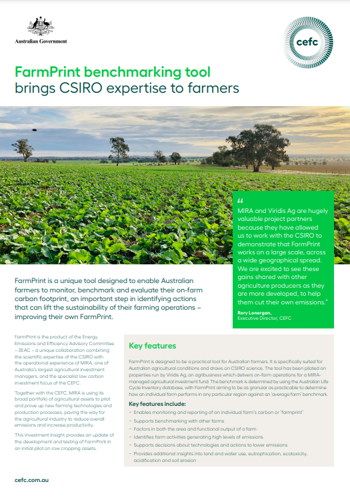
FarmPrint - a practical approach to sustainable agriculture
The CEFC backed the development of FarmPrint through its investment in Macquarie Agriculture Fund – Crop Australia 1. This Insight explores the initial methodology informing FarmPrint and highlights the potential benefits for farmers using the tool. Access FarmPrint via the CSIRO website.
Read more