
Navigating investment in green data centres: 5 insights for investors
The recent CEFC Green Room webinar brought together leading voices in sustainable infrastructure to examine the growing intersection between Australia’s digital expansion and its clean energy ambitions.
Moderated by Julia Hinwood, CEFC Head of Infrastructure, the session featured insights from Rebecca Vallance, Senior Manager, Baringa, and Cornelia Gomez, Managing Director, Global Head of Sustainability, General Atlantic, who discussed the CEFC’s landmark report, Getting the balance right: data centre growth and the energy transition .
The discussion found that there are significant opportunities for investors to contribute to a future where data centre growth supports the clean energy transition. Below are five insights shared by the panellists.
1. Australia has a golden opportunity to build a sustainable data centre industry
“The data centre investment opportunity is unparalleled. Australia's access to clean energy, land availability, data sovereignty laws, geopolitical stability, subsea connectivity: all of those factors mean that Australia, in our view, is likely to continue to rank highly in terms of development opportunities”Rebecca VallanceSenior Manager, Baringa
The report also found the potential benefits are not limited to data centre developers. Vallance continued, “Data centre demand is not just a challenge, it's a financing anchor for clean energy. It could expedite significant renewable and storage investment as data centres will create long-dated stable electricity offtake requirements, and these will be backed by strong credit counterparties who are able to utilise products like power purchase agreements (PPAs). So, it's a real opportunity if managed correctly.”
2. Data centre growth could drive a ten-fold increase in energy demand
The CEFC / Baringa report created two cases to assess grid impacts in this study, with the central case taking a pragmatic view of the project pipeline being built, assuming that only projects with approval will be built this decade and a 50% growth rate beyond 2030. The high case, assumes all projects in the pipeline come online with growth maintaining the same trajectory post-2030. Even under the central case, Australia’s total operational data centre capacity is expected to be at least four times larger than current levels by 2035, and is projected to account for 8 per cent (central case) to 11 per cent (high case) of Australia’s total electricity consumption, up from about one per cent in 2025 (as shown in Figure 1).
“We have a great illustration of the juxtaposition of opportunities and challenges presented by the projected data centre development in Australia. On the one hand, we have an $85 billion to $135 billion investment opportunity and that's from data centres alone - it doesn’t include the knock-on impacts of investment in the energy sector. And on the other hand, we have the challenge that the data centres create for the energy system,” Vallance said.
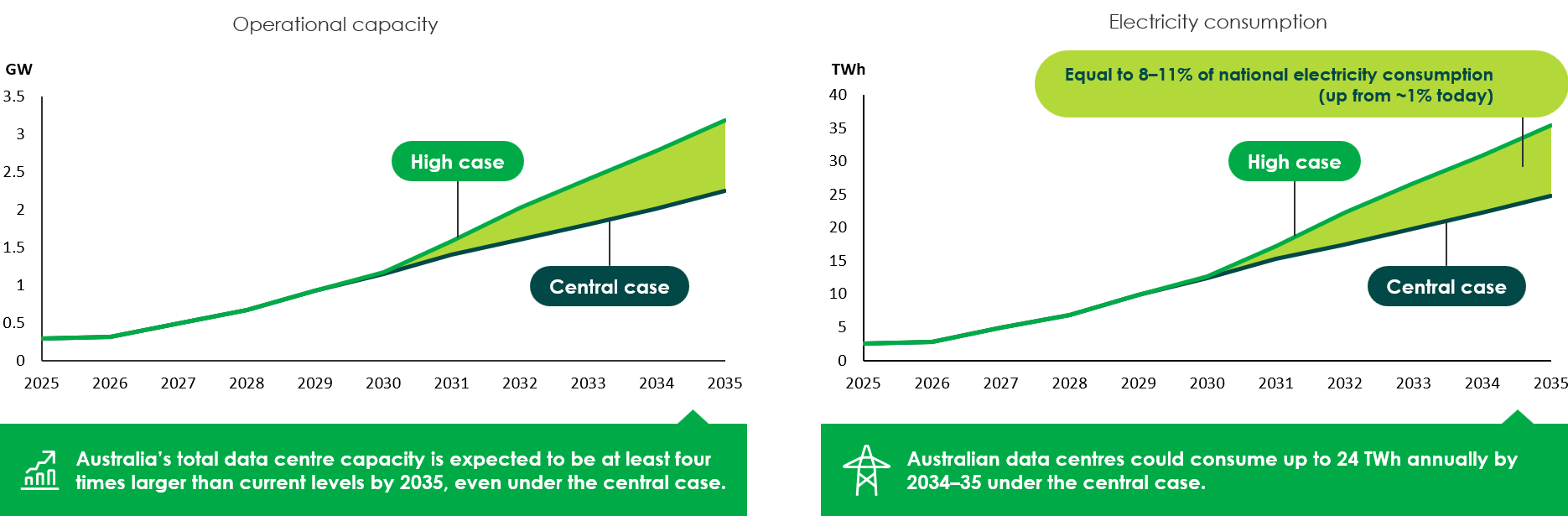
Source: Baringa developed a bottom-up project pipeline of rated capacity, applying a ramp–up period based on AEMO assumptions by data centre type and size. Additional sources include Empowering Australia’s digital future, Mandala; and Forecasting Reference Group May presentation and 2024 ISP, AEMO.
Figure 1. Projected operational capacity and electricity consumption of data centres by 2035
3. Additional renewables and storage are critical to meeting the energy challenge
The report modelled four scenarios to meet the central case demand, highlighting a range of possible outcomes. These scenarios spanned from data centre growth occurring without corresponding investment in renewable generation and storage, through to a case where an additional 3.2 GW of renewable capacity and 1.9 GW of storage are deployed across the grid.
As shown in Figure 2, without additional renewable energy and storage, data centre growth could increase wholesale electricity prices by 26 per cent in NSW and 23 per cent in Victoria by 2035, relative to the baseline scenario. This is driven by increased reliance on higher-cost gas peaking generation, and would also result in a 14 per cent increase in National Electricity Market emissions. By contrast, the addition of renewable energy and storage limits price impacts to 3 per cent in NSW and 2 per cent in Victoria, while reducing grid emissions by around 1 per cent.
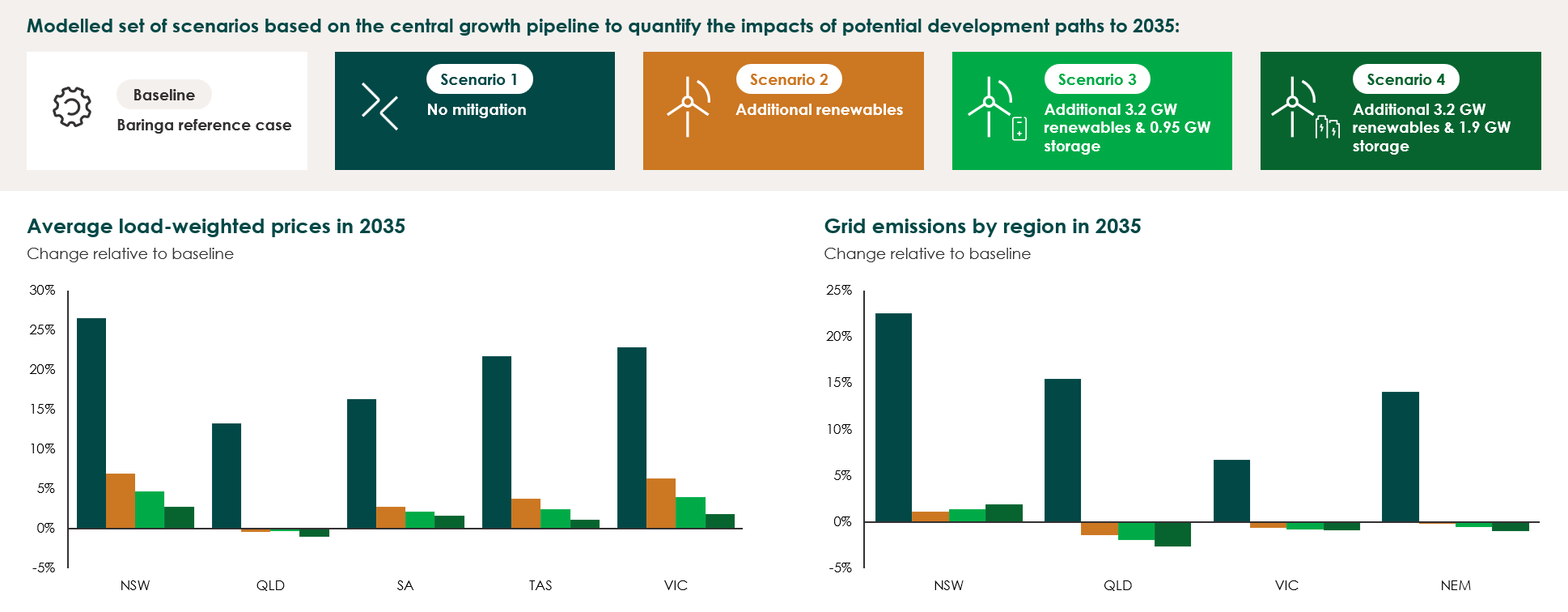
Note: The Reference Case is Baringa’s best estimate for the future of electricity markets, incorporating trends in demand, capacity, policy and market dynamics to project prices and emissions under current assumptions.
Figure 2. Projected impact of renewables and storage on prices and emissions
Vallance said, “Through our modelling, we can see [data centres] reducing curtailment, but conversely, they increase the base load during peak periods in the morning and evening as well as overnight, where we become more reliant on more expensive thermal generation. And that's typically what pushes up the price impacts. Building out battery storage systems to capture excess daytime renewables and discharging them in the morning and evening peak periods will alleviate this impact.”
4. Sustainable design can catalyse data centre growth
General Atlantic and Systemiq’s report on investable green data centres found that making design and operations more sustainable can help developers overcome key barriers facing the sector. The report notes that in the United States, US$64 billion of data centre projects have been delayed or blocked due to community pushback over power and water use1. Sustainable solutions are becoming not just “nice to have” but crucial to de-risking assets and supporting financial and execution goals.
“Our discussions with different stakeholders found that sustainable solutions in this space will scale the fastest if they can solve a bottleneck. The number one constraint that came up all the time was access to power, and exposure to fossil fuels creating volatility. Solutions to address these, such as on-site renewables, storage, micro grids, or demand flexibility software, could be scaled to unlock grid capacity.”Cornelia GomezManaging Director, Global Head of Sustainability, General Atlantic
5. There are opportunities beyond the city limits
Currently, most data centres are built in existing urban hubs. However, co-locating data centres with renewable energy assets – for example, in Renewable Energy Zones (REZs) – could increase efficiency and reduce network constraints.
The Baringa / CEFC report considered the suitability of REZs for data centre growth in the future. Vallance said, “It's definitely worth considering and there is a need for further dialogue between data centre developers, network operators, energy market operators and governments.”
1 Source: Data Center Watch, 2025


