
CEFC and Volvo Group boost battery electric trucks by driving down costs
9 December 2025
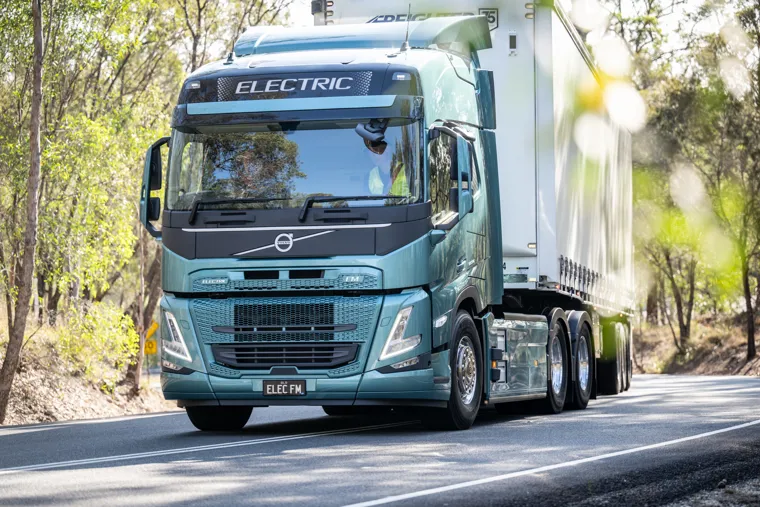
The CEFC is working with one of Australia’s largest onshore vehicle manufacturers, Volvo Group, to accelerate the electrification of the nation’s trucking fleet through an innovative $70 million financing package.
This innovative transaction demonstrates how fleet operators can work with manufacturers and financiers to accelerate the transition to electrification. Reducing some of the financial risk associated with new technologies like BETs, and offering a competitive finance discount, helps lower the premium associated with this new technology. Sharing the risk aligns lenders, manufacturers and end customers in building momentum to help decarbonise our transport sector.Richard LovellCEFC Executive Director
The CEFC finance is targeting heavy-duty battery electric trucks (also known as heavy-duty battery electric vehicles – HD BEVs), as a means of tackling Australia’s substantial transport-related emissions.
Key features of the CEFC finance include:
- Support for an interest rate discount of up to 0.5 per cent for eligible Volvo customers to lease medium and HD BEVs and install EV charging infrastructure,
- Finance for an innovative residual value support mechanism to reduce operating lease costs and support the future value of HD BEVs.
CEFC Executive Director Richard Lovell said: “Our economy relies on the logistics and freight sector to transport goods right around the nation. With other sectors of the economy continuing to decarbonise, transport is expected to become our largest source of emissions as soon as 2030.1 Switching to battery electric trucks is an important opportunity for freight operators and businesses to show real leadership on the path to net zero emissions, while managing a growing freight network and a stronger economy.”
“This innovative transaction demonstrates how fleet operators can work with manufacturers and financiers to accelerate the transition to electrification. Reducing some of the financial risk associated with new technologies like BETs, and offering a competitive finance discount, helps lower the premium associated with this new technology. Sharing the risk aligns lenders, manufacturers and end customers in building momentum to help decarbonise our transport sector.”
Volvo Group Australia has committed to manufacture Volvo electric trucks at its Queensland production facility as part of its broader sustainable manufacturing plans. The company has produced more than 80,000 trucks since it began manufacturing at Wacol in 1972.2
Volvo Group Australia President and CEO Martin Merrick said: “The announcement of this finance comes at a critical time for Australia’s net zero ambitions. We know the cost of entry is a significant hurdle to overcome for many of our customers wanting to take the first steps towards implementing electric transport solutions in their businesses.”
Volvo Financial Services Managing Director David McGuire added: “This program is designed to make the transition more affordable, allowing more of our customers to take that first vital step towards a fossil-free future for the benefit of all Australians. I have no doubt that working with the CEFC will act as a key enabler that will help drive the uptake and adoption of heavy electric vehicles.”
David Bertini, Director Sales and Market Development Volvo Financial Services said: “Leadership today means driving real change — and this new work with CEFC will help lead the industry’s shift to lower-emission freight across Australia. Our customers are ready to make the transition, and this initiative significantly expands where that’s possible.”
Zero and low emissions trucks can be two to four times more expensive to purchase than a diesel truck for the same task.3 While it is common for operators to lease heavy trucks, the high cost of BEVs and uncertainty about their depreciation rate compared to diesel equivalents is reflected in lower residual value expectations, and increased leasing costs.
Transport accounts for up to 22.3 per cent of Australia’s national emissions,4 and is the fastest growing source of emissions.5 Road transport makes up 84 per cent of all transport emissions.6 BETs represent a substantial opportunity to decarbonise the sector, but current sales are insignificant.7
To 30 June 2025, the CEFC has directly committed over $200 million in electric vehicle related projects since its inception to help decarbonise Australia’s transport sector. Investments have included backing Australia’s first electrified bus fleet and increasing EV infrastructure with JET Charge. The CEFC has also helped finance more than 15,000 electric vehicles, exceeding $1 billion in value, including third-party capital through its co-finance programs.
1 Australian Government, Department of Climate Change, Energy, the Environment and Water, Australia’s National Greenhouse Accounts, 2024.
3 Truck Industry Council, Zero Emission Truck Market Update, Issue 1: Jan-Jun 2023, p38.
4 Australian Government, Department of Climate Change, Energy, the Environment and Water, Quarterly update of Australia’s National Greenhouse Gas Inventory, December 2024. p10.
5 Climateworks, Decarbonising Australia’s transport sector: Diverse solutions for a credible emissions reduction plan, June 2024.
6 Australian Government, Department of Infrastructure, Transport, Regional Development and the Arts,
7 94 truck sales for 2023 were battery electric out of a total 44,379 trucks sold according to the Truck Industry Council. Trucksales, Australia’s first low-zero emission market update.
Related media


