
Cleaner, quieter grocery deliveries with Zenobē, Woolworths
Electric trucks give low emissions edge to grocery deliveries
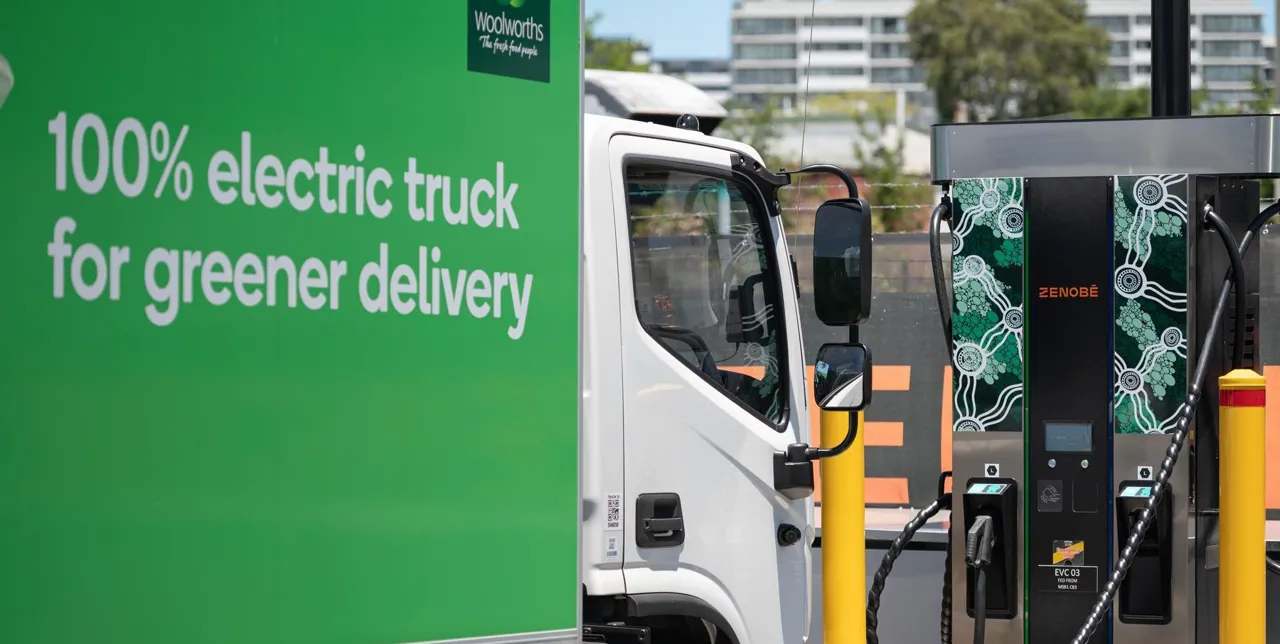
Global electric fleet specialist Zenobē is drawing on CEFC finance to purchase battery electric trucks for cleaner, greener Woolworths grocery deliveries.
$28 million
CEFC commitment
200+
light trucks
Speeding up
EV transition
Together with Woolworths and the CEFC, we’re proving that large-scale zero-emissions logistics is no longer a pilot, it’s commercially viable and operationally proven.Gareth RidgeCountry Director of Electric Vehicle Fleets, Zenobē
Our investment
The CEFC has committed a total of $28 million across two facilities to accelerate the rollout of more than 200 Battery Electric Trucks (BETs) on Australian roads.
The CEFC committed up to $6 million in 2025 to support 60 BETs for ‘last-mile’ deliveries - the final leg of the delivery journey to homes and businesses.
The 60 BETs were part of a broader project funded by ARENA and electric fleet specialist Zenobē, which included the development of Australia’s first off-site multi-user charging hub for BETs in Mascot in Sydney.
Zenobē owns and operates the site. Its trucks are leased to Woolworths under an Australian-first electric-vehicle-as-a-service business model.
The CEFC committed a further $22 million in June 2026 to enable the additional large-scale rollout of up to 148 BETs. The Zenobe-owned BETs expand the capacity of Woolworths electric delivery fleet across New South Wales, Victoria, Queensland, Western Australia and South Australia.
OUR IMPACT
Driving decarbonisation of transport
Transport is expected to be Australia’s largest source of emissions by 2029, without intervention.1 Road freight emissions are about five times higher than those from rail and domestic shipping put together,2 so BETs represent a substantial opportunity to decarbonise the sector.
Replacing diesel vehicles with electric trucks helps reduce emissions in the transport sector, however, truck fleet electrification presents significant operational and logistical challenges.
The complexity of the broader freight and logistics sector compounds barriers to entry, including high upfront costs, insufficient charging infrastructure, battery replacement and grid integration.
Learn more about how the CEFC is working to decarbonise heavy transport.
Leasing model demonstrates commercial viability
Last-mile delivery operations are suited to electrification, with predictable routes, high vehicle utilisation and depot-based operations.
The Zenobē leasing model means major logistics and freight operators and users can transition to electric vehicles without significant capital expenditure. Zenobe handles the upfront cost and complexity of fleet electrification and manages the transition so customers can focus on their core business.
The CEFC finance to increase the uptake of BETs helps develop the market to bring the trucks closer to price parity with their non-electric counterparts.
With fuel price volatility and supply risks increasingly material for freight operators, early large‑scale deployments of BETs are critical to generating the real‑world performance data and operating benchmarks needed to underpin a secondary market for electric heavy vehicles.
A proven track record
The CEFC previously backed Zenobē and Transgrid to own, operate and lease electric buses and infrastructure to Transit Systems and Transport NSW as part of a landmark project to establish Leichhardt bus depot in Sydney as Australia’s first fully integrated EV bus depot.
1 Baseline scenario, Australian Government, Department of Climate Change, Energy, the Environment and Water, Australia’s emissions projections 2022, p9.
2 Climateworks Centre, Delivering freight decarbonisation: Strategies for reducing Australia’s transport emissions summary report October 2023.