
Powering the battery revolution
Powering the battery revolution
27 August 2026
Over the past decade, the development of utility scale battery technology – or ‘big batteries’ – has changed the Australian energy landscape. The CEFC’s early investment in this technology helped demonstrate commercial viability, crowd in private capital and accelerate market confidence. Now, this type of storage is playing an increasingly critical role in Australia’s grids.
On the battery frontier
Up until the mid-2010s, the renewables build-out in Australia focused on generating electricity through wind and solar.
Monique Miller, Chief Investment Officer, Renewables and Sustainable Finance at the CEFC, led the organisation’s early solar investments more than a decade ago and has played a key role in supporting the rapid growth of Australia’s renewables industry. She said the early debate often focused on reliability:
 The question of what happens when the sun doesn’t shine and the wind doesn’t blow was controversial, with critics doubting whether renewable energy could ever reliably ‘keep the lights on’. Battery technology became an important part of the solution, helping renewables provide fast, flexible support when supply and demand move out of balance.
The emerging technology attracted interest from the CEFC. In 2015, Sandfire Resources, owners of the DeGrussa copper mine in Western Australia, wanted to reduce the mine’s reliance on diesel power generation. It engaged Neoen to install a 10.6 MW solar PV system and 6 MW/1.8 MWh lithium-ion battery energy storage system (BESS) at the remote site. The CEFC provided $15 million in financing (alongside funding from ARENA) for what proved to be a truly pioneering project.
The DeGrussa Solar Project attracted interest in Australia and globally, after it successfully demonstrated that solar, battery and diesel hybrid systems could be deployed in critical-load, off-grid industrial settings.
“The lessons learned in this project went beyond the resources sector, providing the CEFC, Neoen and the broader market with valuable experience about battery capabilities, firmware and technical integration,” Miller said.
The big battery bet
In March 2017, Tesla CEO Elon Musk and Atlassian co-founder Mike Cannon-Brookes engaged in a famous Twitter exchange. The context was South Australia’s energy crisis: a statewide blackout in September 2016 was followed by load-shedding events in February 2017, then high electricity prices. Grid stability had become a major public issue.
The SA Government was already preparing an energy plan, including a renewable technology fund and potential utility scale battery support, when Musk tweeted: “Tesla will get the [battery] system installed and working 100 days from contract signature or it is free”. This put huge public pressure on the Government to act.
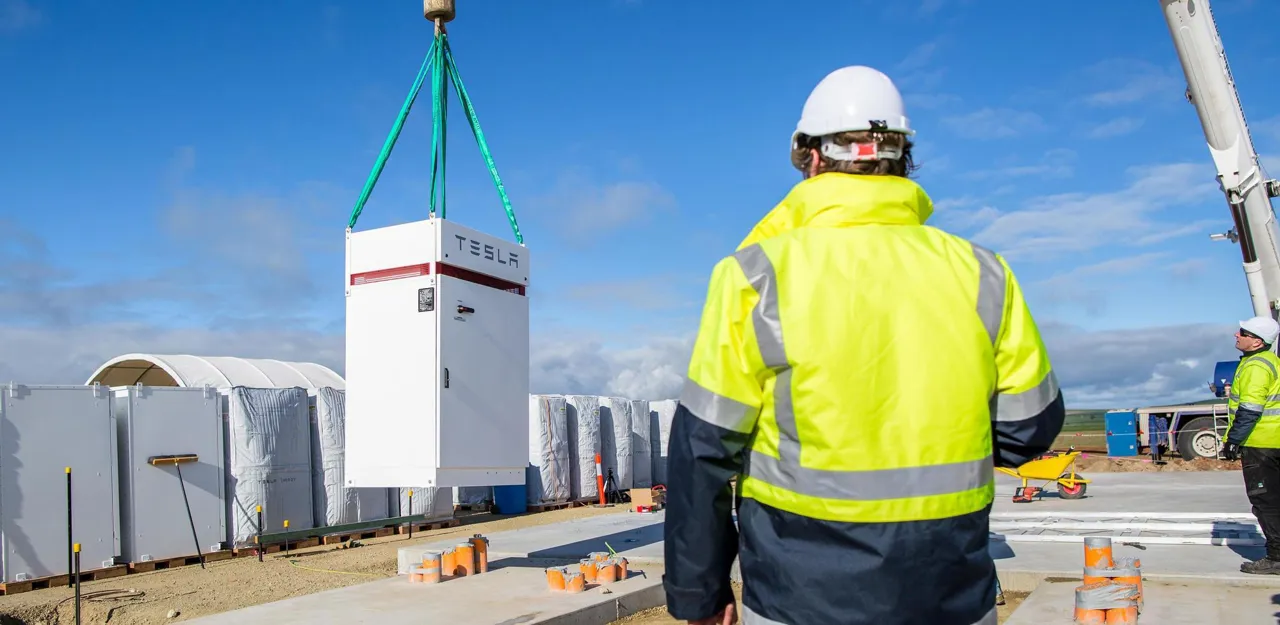
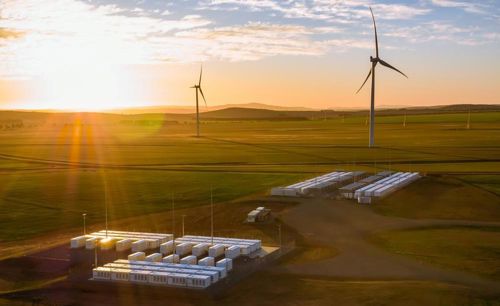
Fortunately, Neoen already had an available transformer at its Hornsdale Wind Farm site. Working with Neoen to leverage this existing infrastructure, Tesla connected to the grid on 1 December 2017, ahead of the 100-day deadline. At 100 MW/129 MWh, the Hornsdale Power Reserve was the biggest lithium-ion battery in the world at the time. Utility scale batteries had now officially entered the national energy conversation.
A shift in the market
There was initial uncertainty about the role a large battery could play in the National Electricity Market (NEM). However, Hornsdale’s response to grid events demonstrated the speed and value of battery storage, showing how it could respond rapidly when the system was under stress, including events elsewhere in the NEM – even interstate.Jean-Christophe CheylusCEO, Neoen Australia
Stage 2 of Hornsdale reinforced this momentum. In 2019, the CEFC made its first investment in a standalone utility scale battery, committing $50 million to add 50 MW/64.5 MWh of capacity to Hornsdale Power Reserve. At this point, traditional financing options were still limited, with lenders cautious about battery revenue models. Innovative CEFC finance, accommodating flexibility for the untested nature of battery revenues at the time, helped bridge that gap, supporting Hornsdale’s expansion at a critical point in the market’s development.
“As the project proved its performance and revenue potential, the economics of big batteries became clearer, helping shift the technology toward mainstream financing,” Cheylus said.
The market soon moved from demonstration to replication. In 2021, the CEFC once again partnered with Neoen, investing $160 million to finance the design, construction and operation of the 300 MW/450 MWh Victorian Big Battery (VBB)i. Built in less than a year, it was the largest battery in the Southern Hemisphere at that time.
The VBB built on the lessons from Hornsdale, adding capacity for summer demand and acting as a “virtual transmission line”, providing contingency support that allowed the Victoria-NSW interconnector to run at a higher capacity without needing to add poles and wires. The CEFC financed the project on a standalone basis but with the broader aim of crowding in private capital.
The next stage of market development saw increasing support for utility scale battery storage among both investors and lenders. In 2022, the CEFC committed $35.5 million toward the Neoen owned and operated 100 MW/200 MWh Capital Battery in the ACT, and introduced co-lender Infradebt to the project, demonstrating its ability to attract private debt capital and support the emerging industry.
Hornsdale proved that batteries could provide synthetic inertia, acting as a digital shock absorber and allowing the grid to run safely on a higher penetration of wind and solar powerii. The VBB then served as a pivotal proof-of-concept for grid-forming technology in Australia. While initially commissioned as a traditional "grid-following" asset, its multi-stage retrofit and testing program demonstrated that massive, software-driven batteries could successfully provide key grid services traditionally provided by fossil-fuel generators to keep the NEM stable.
“Neoen’s Hornsdale and VBBi projects impressed the market with both their financial and operational performance. Not only did the revenue models stack up, but the batteries could also inject or absorb power quickly, helping stabilise the grid and manage volatility across the NEM. They showed that big batteries could be reprogrammed to provide different services as market needs change,” Miller said.
These advances pointed to an increasingly sophisticated role for batteries to keep the grid stable as more renewables enter the system.
Transforming the grid
As more batteries have entered the market and the supply of these services has increased, price spikes have decreased, the revenue focus has shifted towards more stable arbitrage opportunities: charging when power is cheap and discharging when prices are higher.
Recent data from the Australian Energy Market Operator (AEMO) reveals how batteries are increasingly displacing gas in peak periods and helping lower wholesale electricity prices and volatility. As shown in Figure 1, batteries are charging more during the day, enabling them to discharge more in the evening peak period (an increase of over 1,000 MW or 228 per cent). Together with higher wind output, this reduced the need for higher cost gas-fired generation, with average gas output in these hours declining by over 1,400 MW or 45 per cent. Overall, this has helped to reduce gas-fired generation by 30 per cent over the past quarter, bringing it to its lowest Q2 average since 2003.
The rapid growth in battery participation also had a material impact on market outcomes. When combined, battery charging and discharging became the NEM’s most frequent price-setting technology, setting spot prices more often — 36 per cent of the time, up from 17 per cent — while gas set prices less often, as shown in Figure 2.
“Ultimately, batteries are providing fast, multi‑service, day‑to‑day firming and placing downwards pressure on wholesale electricity prices during ordinary market conditions, while gas peakers increasingly function as insurance for rare extremes,” Miller said.
Figure 1: Change in NEM generation and storage by time of day, Q2 2026 vs Q2 2025
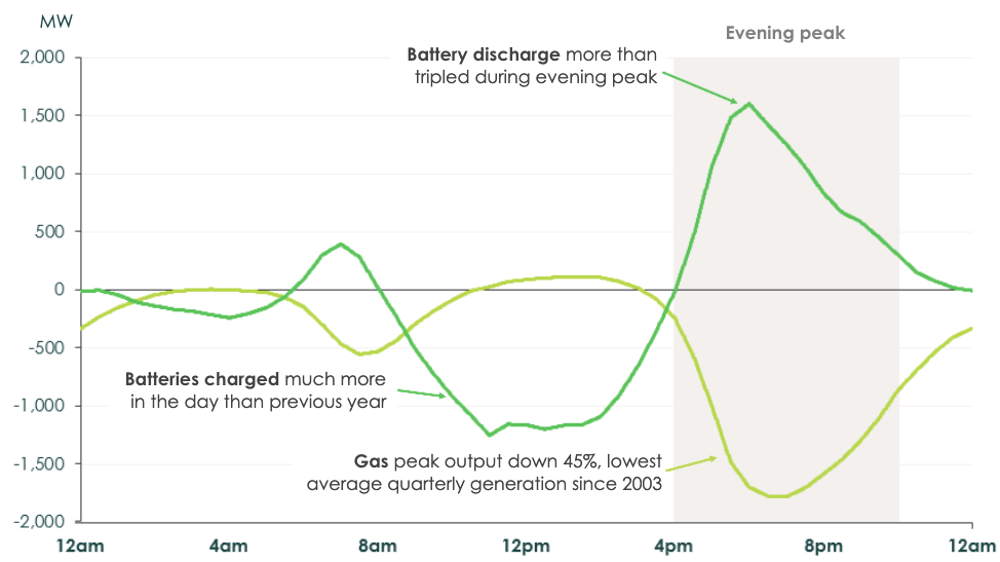
Source: CEFC analysis of Quarterly Energy Dynamics Q2 2026, AEMO. Note: Battery changes are presented on a net basis, with increases in supply (discharging) being positive and increases in load (charging) being negative.
Figure 2: NEM price-setting frequency and price
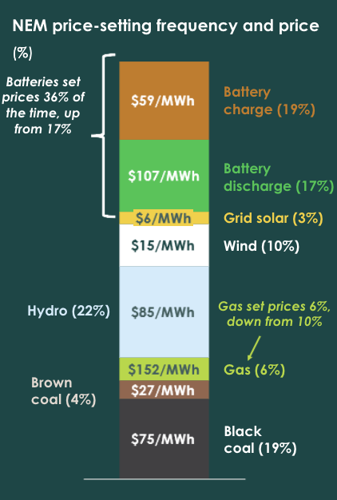
Source: CEFC analysis of Quarterly Energy Dynamics Q2 2026, AEMO. Note: Battery changes are presented on a net basis, with increases in supply (discharging) being positive and increases in load (charging) being negative.
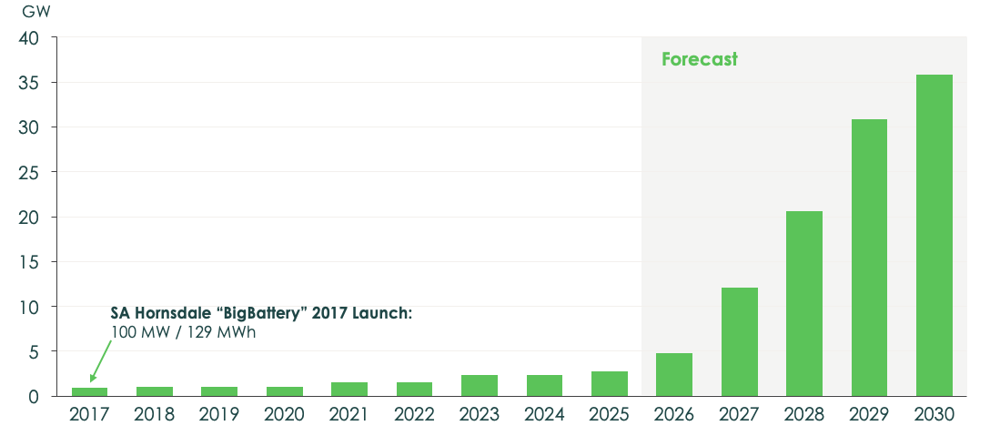
Figure 3: NEM utility scale storage capacity
Source: 2026 ISP, AEMO.
A bright future for storage
Almost a decade after Hornsdale Power Reserve showed the potential of utility scale batteries, the sector has moved from demonstration to scale. Hornsdale’s original 100 MW/129 MWh build was the world’s first big battery; today, the Waratah Super Battery in NSW is expected to reach 850 MW/1,680 MWh, more than eight times Hornsdale’s original power capacity and around 13 times its energy storage. This growth is also visible across the wider market. AEMO’s latest Quarterly Energy Dynamics reportiii showed utility scale battery capacity in the NEM had more than doubled over the past year to exceed 9 GW, while the 2026 ISP points to about 33 GW of utility scale batteries needed by 2030. Battery connections are progressing ahead of expectations, with around 43 GW in the connection pipeline expected to be delivered by 2030, underscoring the momentum behind the sector.
Storage is also scaling on the customer side of the meter. Small-scale batteries are being embraced by Australians, supported by the Cheaper Home Batteries Program, adding a more distributed layer of storage alongside the rapid build-out of utility scale projects. Across the country, there are now more than 400,000 batteries installed in homes and businesses under the programiv.
An essential enabler of Australia’s clean energy system
CEFC investment, alongside market leading project developers, has helped demonstrate the technical and commercial performance of batteries, supporting wider market confidence, with Australia’s battery portfolio generating practical learnings that continue to inform new projects, including design, safety, system security and grid services across the world.
“Battery storage has shifted from an emerging and uncertain technology to an essential enabler of Australia’s clean energy system. Early projects showed that batteries could do more than store renewable energy: they could help stabilise the grid, respond quickly to system events, reduce reliance on higher-emissions peaking generation and create new revenue opportunities,” Miller concluded.
i Now owned by HMC Capital
ii Because batteries have no moving parts, they cannot provide physical mechanical inertia. Instead, they use advanced grid-forming inverters to digitally mimic this behaviour with ultra-fast software and power electronics. Hornsdale demonstrated that large batteries can provide synthetic inertial response through advanced inverter controls. HPR was able to mimic aspects of synchronous-machine behaviour during grid disturbances, helping arrest frequency changes and support system stability. Subsequent testing showed HPR could provide virtual inertia, with the measured response closely aligning with modelled performance during real grid events. This is an important capability as the NEM integrates higher levels of inverter-based renewable generation, and AEMO plans for periods of very high instantaneous renewable output.
iii AEMO Quarterly Energy Dynamics report Q2 20206 https://www.aemo.com.au/newsroom/media-release/qed-q2-2026
iv Clean Energy Regulator, Quarterly Carbon Market Report, March quarter 2026
For further reading:
ARENA Report on Hornsdale: https://arena.gov.au/knowledge-bank/neoen-hornsdale-power-reserve-upgrade-project-summary-report/
ARENA Report on VBB: https://arena.gov.au/projects/neoen-victorian-big-battery-moorabool/


