

The next wave of home energy upgrades
Rooftop solar has transformed how Australians power their homes. Now, households are looking to the next wave of upgrades to take greater control of their energy use and reduce their electricity bills.
 Jeff Sykes, CEO of Solar Choice, an independent comparison and information platform for home energy technologies, explains what’s driving this shift, what consumers should look for when considering upgrades and where untapped opportunities lie.
At a glance
- Households are taking a whole-of-home approach to improve energy efficiency, reduce bills and prepare for their future energy needs.
- Rebates, incentives and discounted finance can help reduce the upfront cost of home energy upgrades.
- Consumers should compare at least three quotes, check supplier and installer credentials, and seek independent information before committing to an upgrade.
- Households with compatible batteries may be able to receive an annual bill credit or financial reward by joining a virtual power plant.
- Vehicle-to-grid technology could turn household EVs into energy assets that reduce bills, earn income and support the electricity grid.
- Apartments remain a significant untapped opportunity, with strong resident interest but complex approvals and shared infrastructure slowing energy upgrade uptake.
In conversation with Jeff Sykes
How are households changing the way they think about home energy upgrades?
The biggest shift I’ve seen is from a narrow focus on solar payback periods to a broader view of how energy is used across the home.
Cost savings remain a key driver, but households are increasingly thinking about whole-home efficiency and future-proofing their home energy setup. Solar has opened the door to a broader conversation about hot water, heating and cooling and replacing gas systems with electric alternatives.
With around 4.5 million solar systems installed nationally,1 solar is mainstream. Other elements of home electrification are still at an earlier stage, and greater access to transparent and independent information is needed to build consumer confidence and momentum.
“Solar really led the way and has now opened the door to looking at all the major energy consuming appliances within a home.”
What major trends are you seeing across home energy upgrades and broader electrification?
The standout trend is the rapid rise of home batteries. In 2024, 74,582 home batteries were installed, compared to 276,011 in the first half of 2026 alone.2 We’re also seeing many existing solar customers returning to add storage, with the Australian Government’s Cheaper Home Batteries Program helping to accelerate that shift.
Electric vehicle purchases are also increasing substantially, overtaking petrol car sales for the first time in Australia in August 2026.3 An EV can become the largest energy load in a home, changing what households need from their solar, battery and electricity plan, so it’s important to choose a system that can expand as household energy needs evolve.
How important are rebates, incentives and discounted finance options for encouraging uptake?
Australia has become a world leader in solar and battery installations per capita, and government incentives have played a major role in that. Incentives and rebates stimulate demand, attract attention and prompt households to consider upgrades that may not otherwise have been on their radar.
Discounted finance is equally important. Not every household can meet the upfront cost, even when an upgrade will lower future energy bills. Programs such as the Household Energy Upgrades Fund can help bridge that gap and make efficient technologies accessible to more Australians.
“Making energy efficient technologies accessible to a greater proportion of Australians is something that’s really important.”
Where are the biggest gaps in home energy upgrades today?
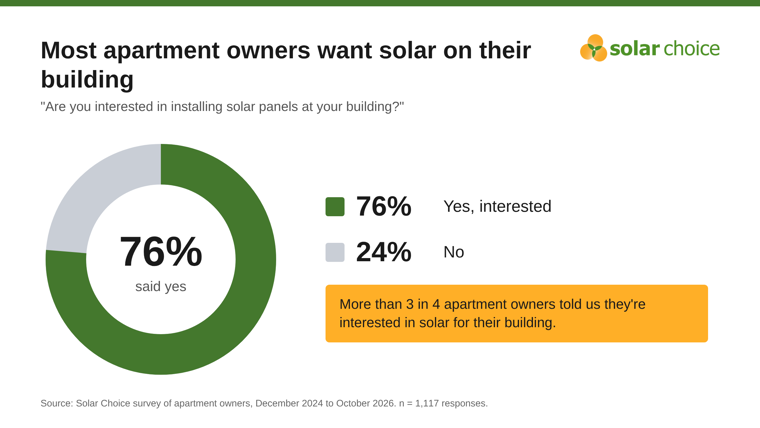
Freestanding homes have been the biggest beneficiaries of existing energy upgrade programs. I see apartment buildings as one of the most important market gaps for us to address. The latest figures show that only 6 per cent of apartments in Australia have solar and just 3 per cent have a battery installed, compared with over 40 per cent of freestanding homes.4 Yet our recent Solar Choice survey of more than 1,000 apartment residents found 76 per cent wanted solar installed. 5
The barrier is often the work required to assess feasibility, obtain quotes and secure owners corporation approval. Sharing more success stories, improving education and considering supportive policy settings could help build confidence in these more complex settings.
What advice would you give households looking to make upgrades to their home?
My first piece of advice is to consider the whole home, not just the next upgrade. Replacing a hot water system or installing solar can shape later choices about batteries, EV charging and electricity use. Ask yourself what the future of your home looks like in the next 5-10 years and tackle it holistically.
Three things to consider before making a home energy upgrade:
- Compare at least three quotes: Assess them on a like-for-like basis so you're getting a competitive solution at the outset.
- Check credentials and support: Confirm the product supplier offers Australian-based technical support and verify the installer’s trading history, ABN and electrical contractor’s licence.
- Seek independent information: Use government resources, reputable comparison services, such as Solar Choice, or community electrification groups rather than relying solely on a sales pitch.
As we head into summer, what practical steps can households take to manage their energy use and reduce their electricity bills?
One of the quickest ways for households to reduce electricity costs is to compare the available electricity plans and switch to a lower-cost option or one that better suits their usage. In summer, running large loads such as pool pumps, air conditioners and dishwashers during cheaper tariff periods can also help reduce bills.
Households in many states can now consider electricity plans that offer free electricity during certain times of the day, which can significantly reduce costs if flexible appliances are shifted into these periods. Over the longer term, installing solar panels and a battery can be one of the most effective ways to minimise household electricity costs.
What is a virtual power plant and how can they play a role in improving a household's energy use?
A virtual power plant or VPP connects a group of household batteries using smart software, allowing them to operate together like a larger power station. When the grid needs additional energy, the VPP can draw power from participating batteries, with households typically receiving a financial reward in return.
If we use a hot summer’s day as an example, when air conditioners are running and electricity demand is high, a VPP can respond automatically by sending energy from participating home batteries back to the grid, reducing household demand or shifting when flexible appliances use electricity.
To participate, a household usually needs a compatible battery and an eligible VPP electricity plan. Rewards can include an annual bill credit, a higher feed-in tariff, or payments when the battery is used by the VPP.
What developments will shape the next wave of home energy upgrades?
Vehicle-to-grid technology is one of the most exciting developments to watch. It allows energy stored in an EV to be exported when the grid needs it, potentially reducing bills or earning income for the household.
For example, I have two EVs with a combined 120 kWh of battery capacity, yet they rarely fall below an 80 per cent charge, leaving most of that capacity unused. Around 500,000 EVs6 are currently on Australian roads, which amounts to an enormous distributed fleet of batteries.
Vehicle-to-grid is not yet mainstream and can affect some vehicle warranties, but trials are expanding. I expect simple services and subscription models to help turn the car from a depreciating asset into one that can reduce bills, earn revenue and support the grid.
“We’d be silly not to try and utilise the enormous fleet of batteries that are sitting in people’s garages.”
[1] https://cer.gov.au/markets/reports-and-data/small-scale-installation-postcode-data
[2] Clean Energy Council, Rooftop solar and storage report January - June 2026
[3] https://minister.dcceew.gov.au/bowen/media-releases/ev-sales-overtake-petrol-cars-first-time
[5] https://www.solarchoice.net.au/commercial-solar/strata-apartments/
[6] https://www.energy.gov.au/electric-vehicles/electric-vehicle-basics/electric-vehicle-facts

