
Agile Energy targets the ‘missing middle’ in business renewables
12 October 2026
A curious divergence has appeared in the way we power homes and businesses in Australia.
More than one in three households have embraced rooftop solar, and over 500,000 batteries have been installed through the Cheaper Home Batteries Program1. By contrast, small businesses have been slower to adopt these technologies, accounting for less than two per cent of installations2.
Home-grown Australian business, Agile Energy (Agile), is working to close this gap by helping the commercial and industrial (C&I) sector make the move to renewables.
Embracing renewable energy can have multiple benefits for businesses, including lower operating costs and reduced Scope 2 greenhouse gas emissions. And yet, while Aussie homes have installed about 22 GW of rooftop solar capacity, C&I premises only have about 6 GW. This is despite the sector consuming more electricity than households, and much of it occurring during daylight hours3.
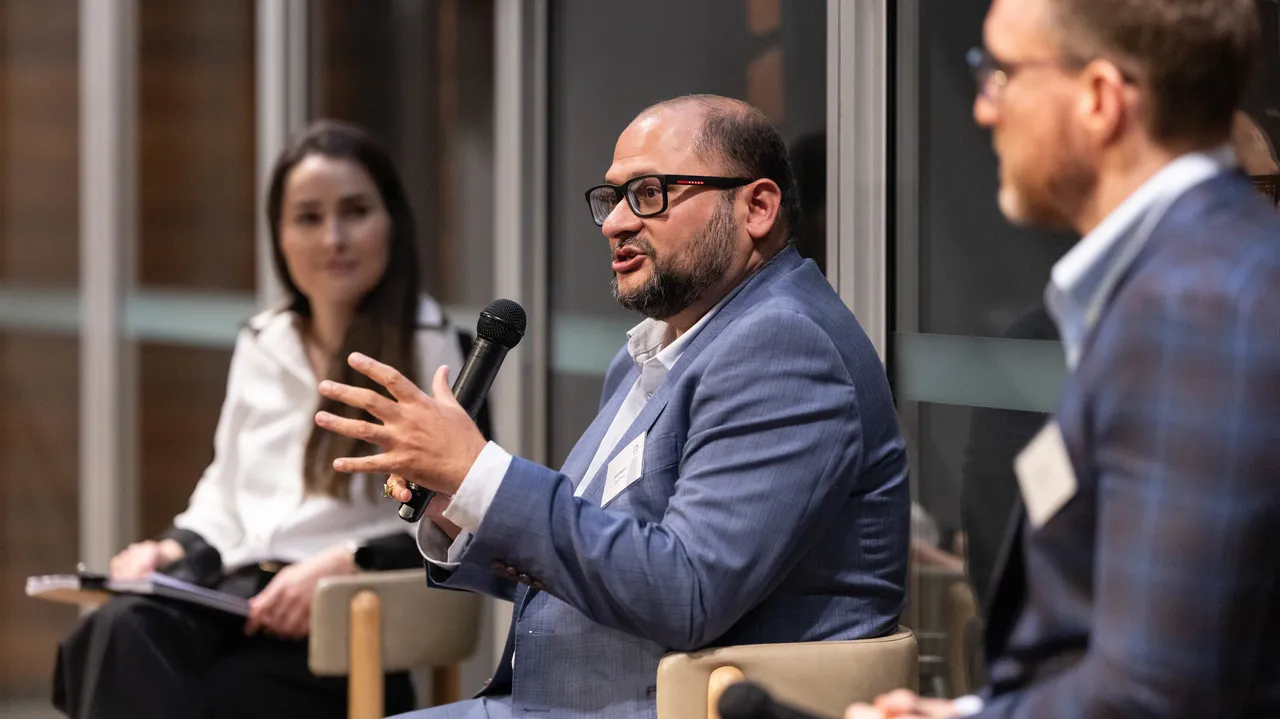
Taking action can be difficult for businesses, according to Agile Energy co-founder Jack Kapoor.
“While the desire for renewable energy exists, the barriers for commercial and industrial are usually capital, complexity, risk allocation and customer bandwidth - not the technology itself.”
The Agile model addresses these barriers by providing an end-to-end solution that assesses energy demand, designs the solution, arranges funding, then builds, owns and operates the asset under a Power Purchase Agreement.
The company was founded by Kapoor, David Margolius, and Nicholas Stavroulakis – a trio who bring complementary backgrounds in corporate strategy, renewable energy and technical delivery, respectively.
They identified a gap in the market: businesses wanted cheaper, cleaner energy but could not justify funding and managing solar or battery assets themselves. Often, the desire was there, but the complexity saw it end up in the 'too-hard basket'.
The Agile value proposition is simple. It provides behind-the-meter solar and battery, delivered under Power Purchase Agreements. This means the customer doesn't have to tap into their own capital to access the contracted savings that come from renewables. Instead, the full lifecycle is owned by Agile.
Reaching the missing middle
Agile identifies a ‘missing middle’ in terms of renewables adoption, between large-scale users and individual homes. The factors behind this are many and varied, including scarce capital, competing priorities and a lack of understanding.
"The energy bill itself can obscure the opportunity, with businesses often focusing on retail electricity rates rather than demand and network charges. We help them see how it all fits together, often working with CFOs and finance teams to compare scenarios, understand the cost savings, and identify the right commercial solution."Jack KapoorCo-founder, Agile Energy
The company's customer base comprises both owner-occupiers of business premises as well as tenants. Because the energy solutions are customised for the business and owned by Agile, tenants can invest in a power system on premises they don't own. This bespoke approach is key to Agile's success, according to Kapoor.
“We undertake a technology-neutral assessment of factors such as load profile, operating hours, roof space, tariffs and future needs. The answer may be solar, a battery or a combined system. We can also review existing systems and have the capability to plan multi-site, multi-year programs,” he said.
The Agile website is populated with case studies notable for their diversity, from a school that cut its power bills by up to 40 per cent, through to a property investment firm that installed nearly 2 MW of solar across its commercial, industrial and healthcare assets.
A boost for business
Agile is predicting an uptick in enquiries following the recent expansion of the Small-scale Renewable Energy Scheme to support solar systems up to 1 MW installed from 1 October 2026. Under the scheme, eligible projects receive certificate-based support, lowering upfront system costs by approximately 20 per cent.
Kapoor said that this is a positive move for the sector.
“This type of support can contribute to stronger project economics, more feasible sites and faster decisions, particularly for medium-sized businesses previously caught between small-scale rebates and large-project economics. We hope it gives some businesses the prompt they need to take action and see the benefits of renewables.”
Agile also hopes to see a boost for its thriving business, which has been backed by the CEFC Powering Australia Technology Fund (PATF) since late 2025. The PATF is a specialist $500 million vehicle that invests in Australian climate tech businesses focused on decarbonisation. Growth-focused private equity and venture capital firm, Five V Capital, also invests in the company alongside the CEFC.
This investment has allowed Agile to accelerate its expansion into broader industries and customer portfolios. However, for the Agile team, the investors have provided more than capital.
“Having the CEFC and co-investor Five V Capital join the Board has provided an uplift in governance, strategic discipline and sector expertise. It has also broadened our networks and provided a level of institutional credibility with customers,” Kapoor said.
The investment comes at a time when the C&I sector is being squeezed by rising costs in areas such as fuel. In this context, renewable energy can provide a welcome source of cost savings.
“At a system level, broad C&I participation can add distributed generation and flexible demand close to where electricity is used. Adding well-designed batteries can also shift solar output into higher-value periods, reduce peak demand and improve use of existing rooftop generation. Not only is this helping cut power bills, it boosts resilience and lowers emissions,” Kapoor said.
Looking ahead, the next step for Agile is to bring its model to more mid-sized businesses across Australia, turning untapped rooftops into productive energy assets.
“With stronger policy support, growing climate-reporting expectations, improved customer understanding and patient institutional capital now converging, onsite clean energy is moving into the commercial mainstream.”Jack KapoorCo-founder, Agile Energy
For Australian businesses, the Agile Energy value proposition means that what was once seen as a specialist sustainability project can now become a practical business decision that lowers costs, reduces emissions and strengthens energy resilience.
3 Unlocking the clean energy potential of Australian business rooftops | IEEFA


